
The basic difference
Single phase supplies power through one alternating voltage system. It is common for household appliances, lights, televisions, small freezers, office equipment and many portable tools.
Three phase uses three voltage waveforms spaced apart. It is common for larger motors, pumps, compressors, workshop machinery and commercial installations designed for three-phase supply.
| Question | Single phase | Three phase |
|---|---|---|
| Typical voltage in PNG | 240V | Usually 415V phase-to-phase and 240V phase-to-neutral, subject to the installation |
| Common users | Homes, small shops, offices and portable equipment | Larger motors, machinery and designed commercial systems |
| Main decision | Your important loads are single phase | You have confirmed three-phase loads |
Choose from the load nameplates
- Choose single phase when all important appliances show 220-240V single phase or 1P.
- Choose three phase when essential equipment clearly shows 3 phase, 3P or a three-phase voltage.
- If a site has both types, an electrician must prepare a load schedule and balance the single-phase circuits across the three phases.
- Send clear photos of every motor and appliance nameplate before final generator sizing.
A three-phase generator is not full power on one outlet
A three-phase generator rating is the combined output of the complete three-phase system. The full rated kW is not normally available from one single-phase leg. Excessive imbalance can cause poor voltage, overheating and loss of usable output.
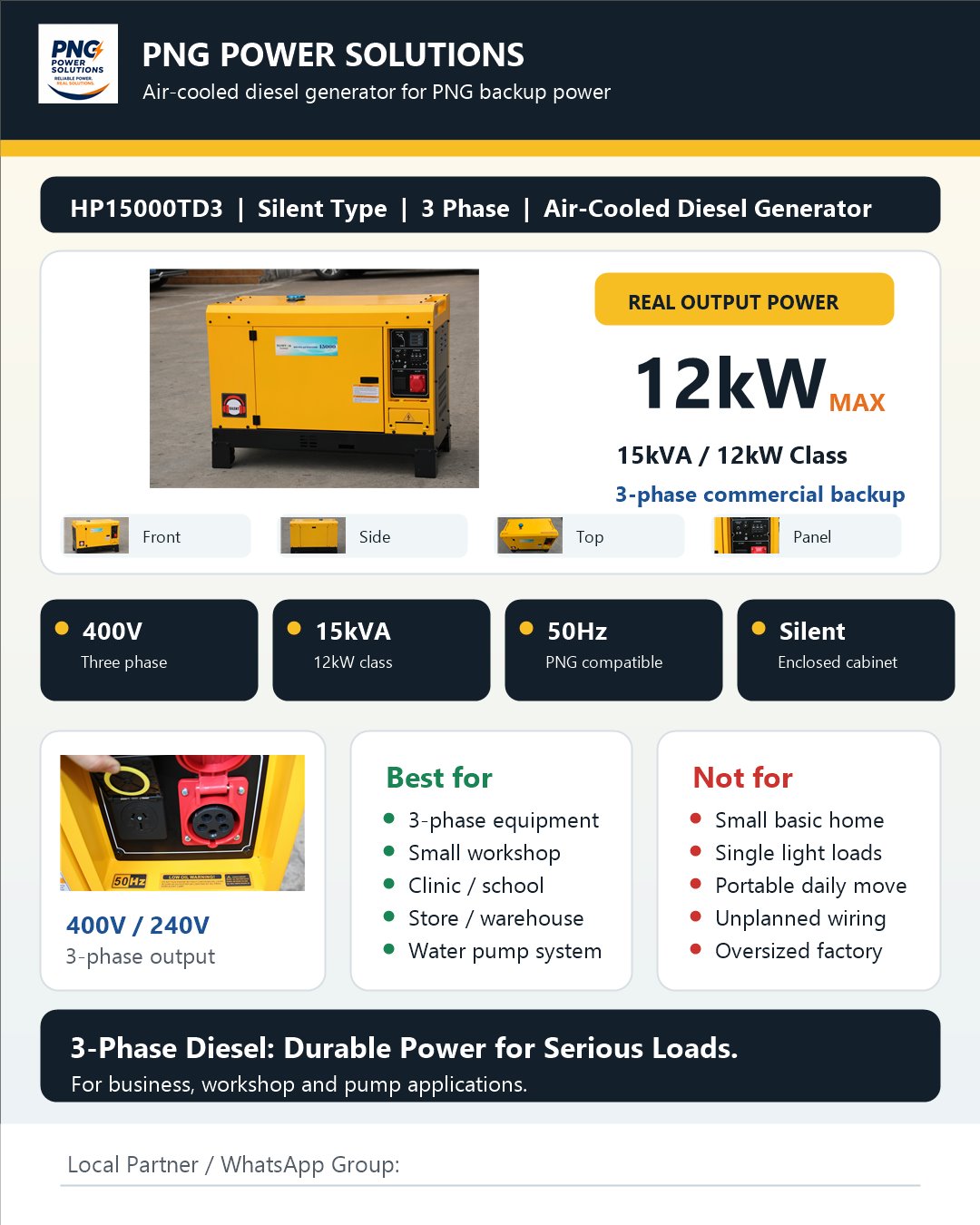
This is why PNG Power Solutions lists the 12kW silent model as three phase without promising a separate single-phase output figure. The actual distribution design must be checked for the project.
Four checks before ordering
- Photograph the voltage, phase, frequency, kW or kVA and current on every important load.
- List which loads run together and which motors start under load.
- Confirm the site's sockets, changeover equipment, earthing and distribution system with an electrician.
- Select generator phase and size only after the load and site arrangement are clear.
Need help with your actual equipment?
Send the equipment nameplates, your location and the loads that must run together.